What is Man?
Our divine origin reveals our divine end.

As explained in a previous post, understanding the nature of a thing and deriving its proper end (telos) are key to ordering it toward flourishing. A chair’s nature is to be sat in, so its proper end is to be used for sitting.
But what is man? What is our proper end?
Man is Rational and Social
Observation and reason show us that we are rational beings, meaning we are capable of reason and ordering our actions in accordance with reason. Unlike animals, we deliberate, reflect, choose, and act according to reason. We are also, by nature, social beings. We find fulfillment in relationship with each other. We naturally form families, communities, and societies. As Aristotle put it, “man is by nature a political animal.”
Because we are rational and social, certain goods naturally fulfill us, and we are internally driven toward them. These goods are intrinsic and knowable by practical reason. We find fulfillment as we exercise our reason and freely participate in goods such as life, knowledge, justice, play, aesthetic experiences, friendship or sociability, deliberation and reasonableness, achievement, productive work, health, moral virtue, and religion.
Our pursuit and participation in these goods constitute human flourishing—what Aristotle called eudaimonia, often translated as “happiness,” but better understood as living well in accordance with our nature.
Flourishing Requires Self-Directed Human Action
But flourishing is not passive. It is the result of human action. Human action is derived from two components: free will and reason.
Free will not only encompasses a lack of coercion, but also that action is the result of will, as opposed to instinctual reaction.
To illustrate, you’re walking through the grocery store, and another shopper is heading down the aisle in the opposite direction. As they pass you by, you suffer a muscle spasm and strike them. Are you morally blameworthy for that act? Was it a human act? No. There was no will involved. The same is true if someone grabbed your arm and struck the other shopper.
Next is reason. Again, our rationality is a key part of our nature and sets us apart, as Aristotle explained, from the animals. To be human, then, an act must be the result of reason – our deliberation, thinking through of values, and then acting on that deliberation. This is a familiar concept, especially in the law.
Going back to the common law, there has long been an understanding that someone is not blameworthy and is excused from blame for otherwise criminal acts when their acts were the result of insanity or duress. If our will is overwhelmed by illness or subjugated by another person, the resulting act is not directed by reason and is not human. Though it may outwardly resemble human action—involving some deliberation—it is ultimately distorted by the superseding will of the illness or the other person. In such cases, the person is an object, not an agent. It thus fails to be a true exercise of reason. Accordingly, the act carries no blame and does not develop virtue.
In sum, because we are rational beings, the goods we must strive for to find fulfillment can only be the result of rational self-direction.
Man is a Theomorphic Being
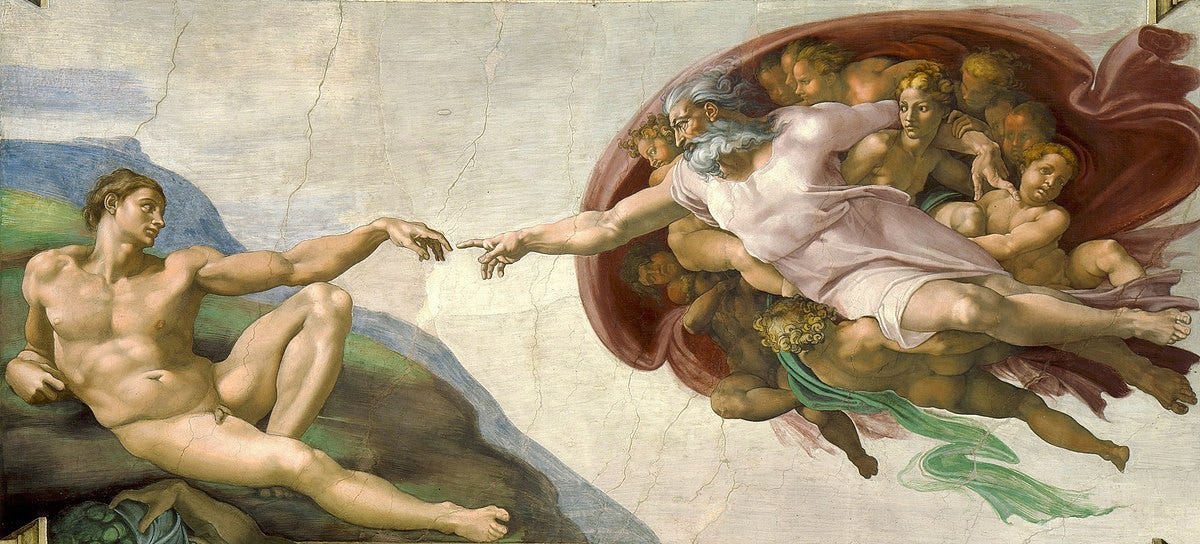
Revealed truth confirms and expands on these principles. Scripture shows that we are created beings, made in the image of God. Thus, each of us has the imago dei, the image of God within our nature. We reflect the divine nature, and Scripture reveals that God is not only rational, using reason (the logos), but He is also love, justice, goodness, virtue, creative, productive, and excellent.
Accordingly, we too act by reason and find fulfillment when we engage in loving relationships, society, goodness, virtue, creation, production, and excellence.
So flourishing is not just self-actualization; it is participation in the Good.
Man’s End is God
But beyond that, Scripture teaches that God intends for us to join Him in relationship and develop His attributes within ourselves—to know Him and to commune with Him.
And here as well, our development of these attributes and, by extension, our flourishing requires human action: free will and reason. We each must “choose this day whom we will serve.” Moreover, God credits our choices only when they are properly motivated. Remember, those who do good for the praise of man have their reward. So flourishing in the highest sense has an added, higher requirement: right motive.
So it is the rational, self-directed, properly motivated pursuit of God, His attributes, and the goods derived from His nature that constitutes our proper end. To the degree we engage in this pursuit, we flourish individually and as a society.
Thus, man is a theomorphic, rational being whose end is the Divine.
Libertas et lux